
The Bridge from Sensorial to Math
by Regan Becker
“From birth through approximately age 6, the young child experiences a period of intense mental activity that allows her to ‘absorb’ learning from her environment quickly and easily without conscious effort.” — Dr. Maria Montessori
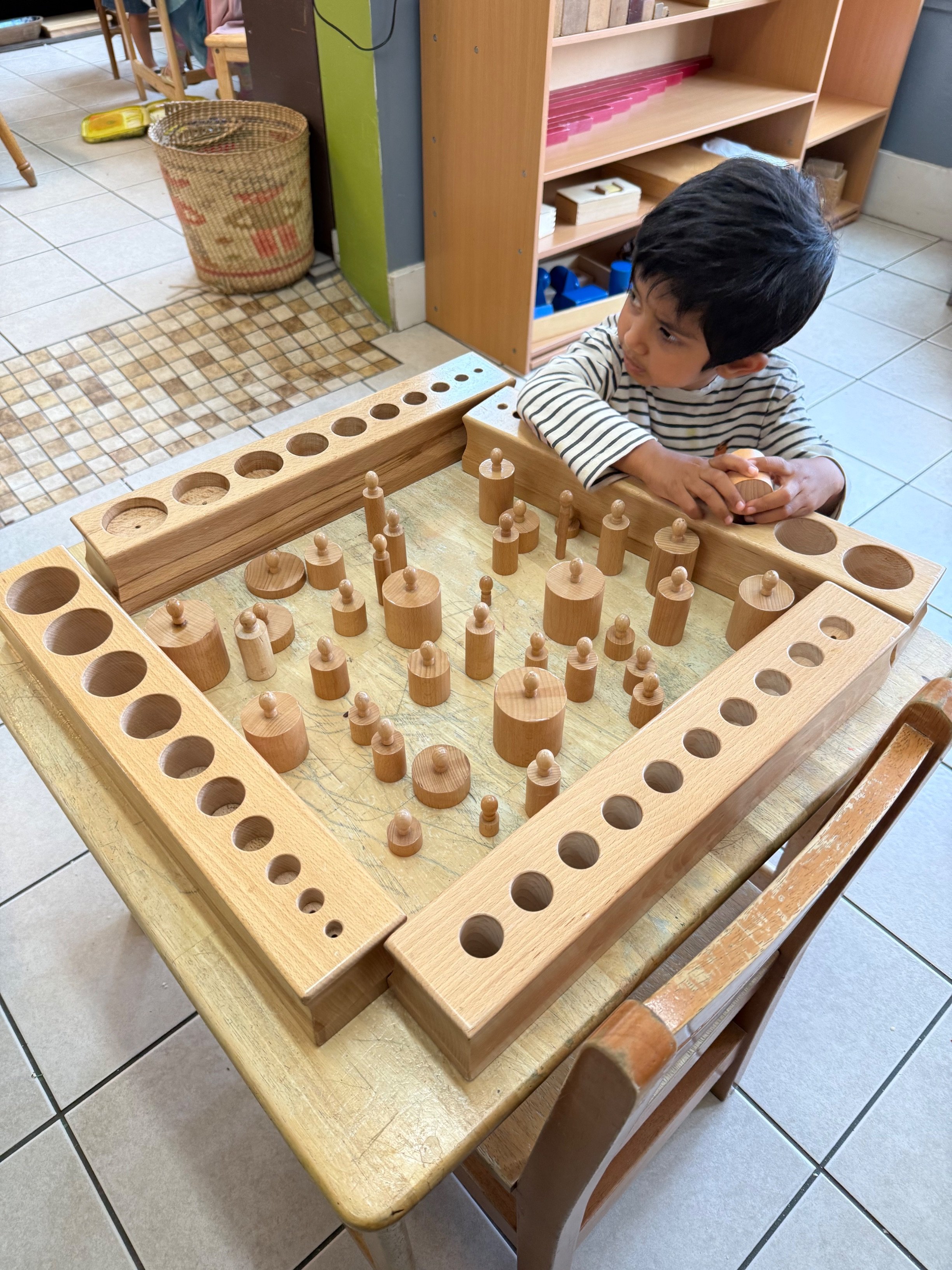
Sensorial: Knobbed Cylinders (multiple blocks)
In a child’s first plane development (ages birth to 6), they have a Sensitive Period for order, as well as human tendencies toward precision, concentration, and repetition. Through first working with the Sensorial materials, the child in a primary Montessori classroom absorbs and synthesizes information as it directly and indirectly relates to Mathematics. A range of Sensorial materials essentially present the question: “What things are alike? What things are different?” (What we might call compare and contrast.)
The 3-6 year old child:
investigates shapes and their corresponding insets,
matches pictures and objects,
explores dimensions in length, width, and height
grades objects by size and color,
and identifies patterns.
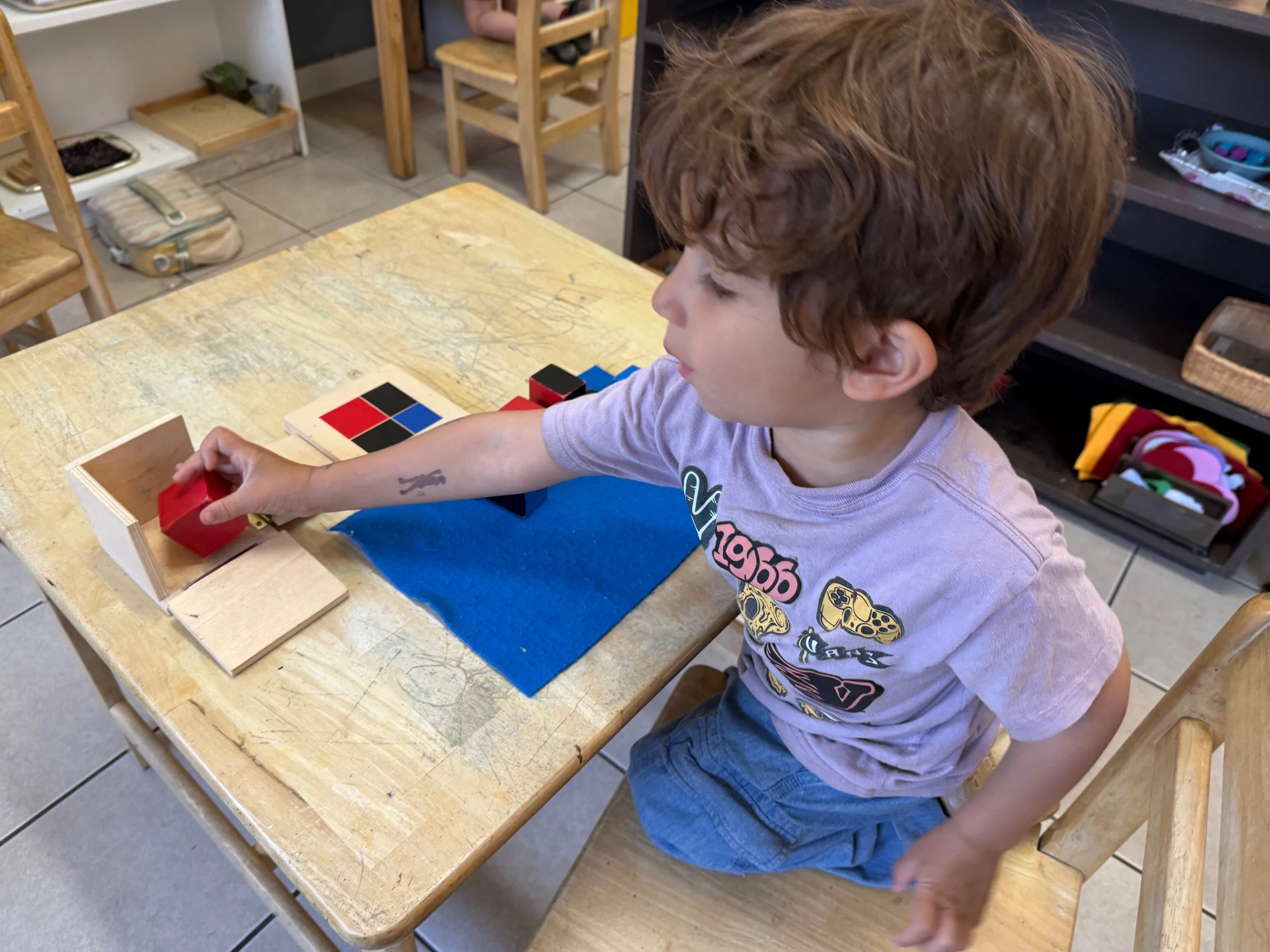
Sensorial: Binomial Cube
“A child who … through long and repeated exercises .. has been encouraged by the pleasant and interesting activities in which he has been engaged, is a child filled with health and joy and remarkable for his calmness and discipline.” — Dr. Maria Montessori, The Discovery of the Child
These Sensorial activities embody pre-Math basic principles via the child’s work with hands-on, didactic materials. Because this work appeals to the child’s innate sense of order, the exercises are carried out with concentration and repetition – as determined by the child rather than made compulsory by the adult. Montessori materials are self-correcting and exploratory, which allows the child to intuit their own understanding through experience, rather than simply being told by an adult a formula (or “trick”) – which is an abstract way to skip the steps of understanding through physical manipulation.
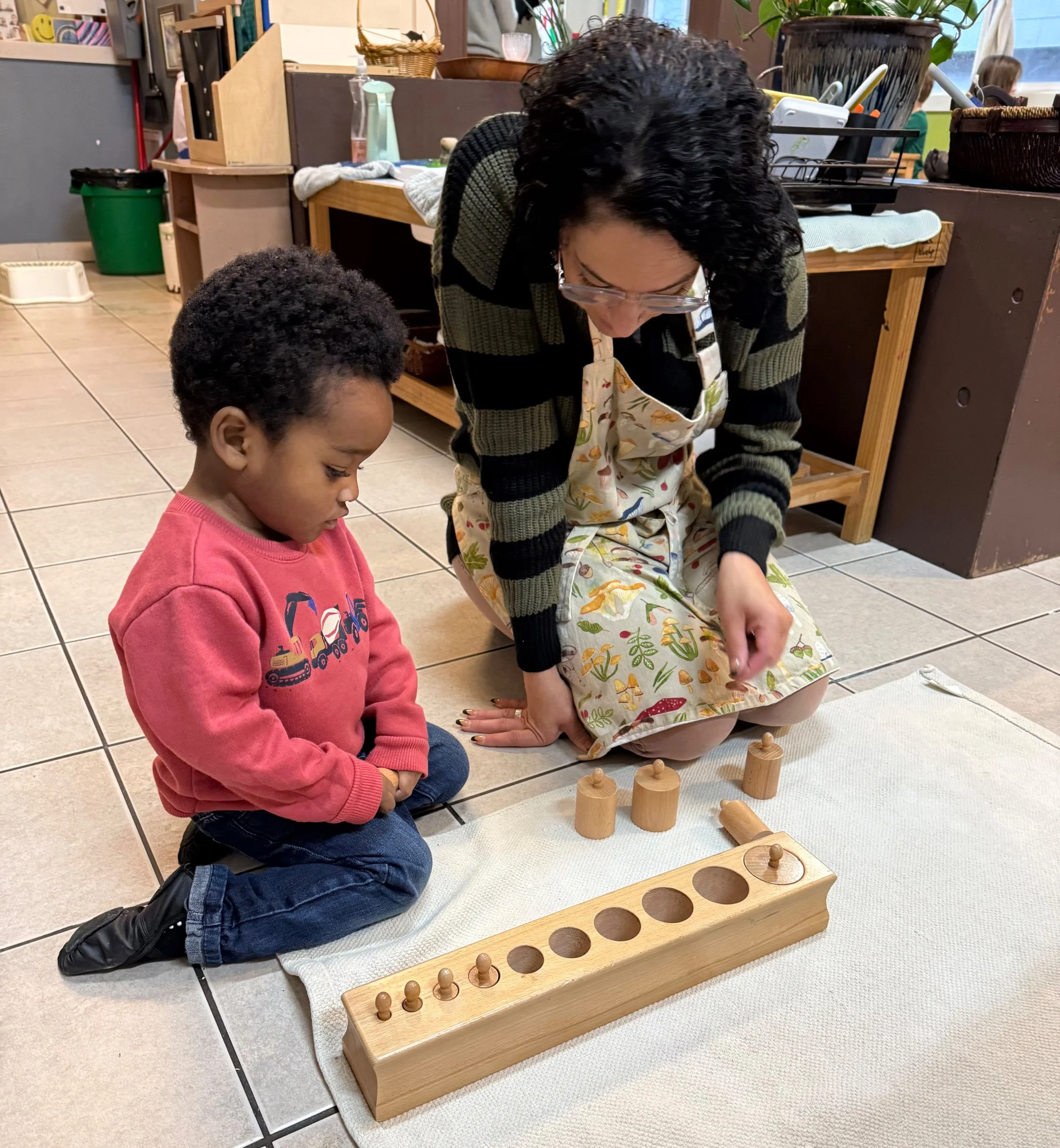
Sensorial: Knobbed Cylinders (single block)
The Knobbed Cylinders, for example, allow the child to practice one-to-one correspondence as they fit each cylinder into its matching socket. Four different sets of “blocks” provide varying dimensions of height and width, advancing in complexity and acting as a visual problem-solving experience. As the child works through these cylinder blocks, they incorporate concepts of dimensionality that they will use later in volume work.
By using Sensorial materials, the child makes sense of Math before numbers are ever introduced. The child recognizes quantities, sequences, and patterns – characteristics of Mathematical thinking. The Math curriculum also includes exposure to fractions and decimals, measurement, geometry, and pre-algebra through Sensorial materials such as the Binomial Cube and Trinomial Cube.
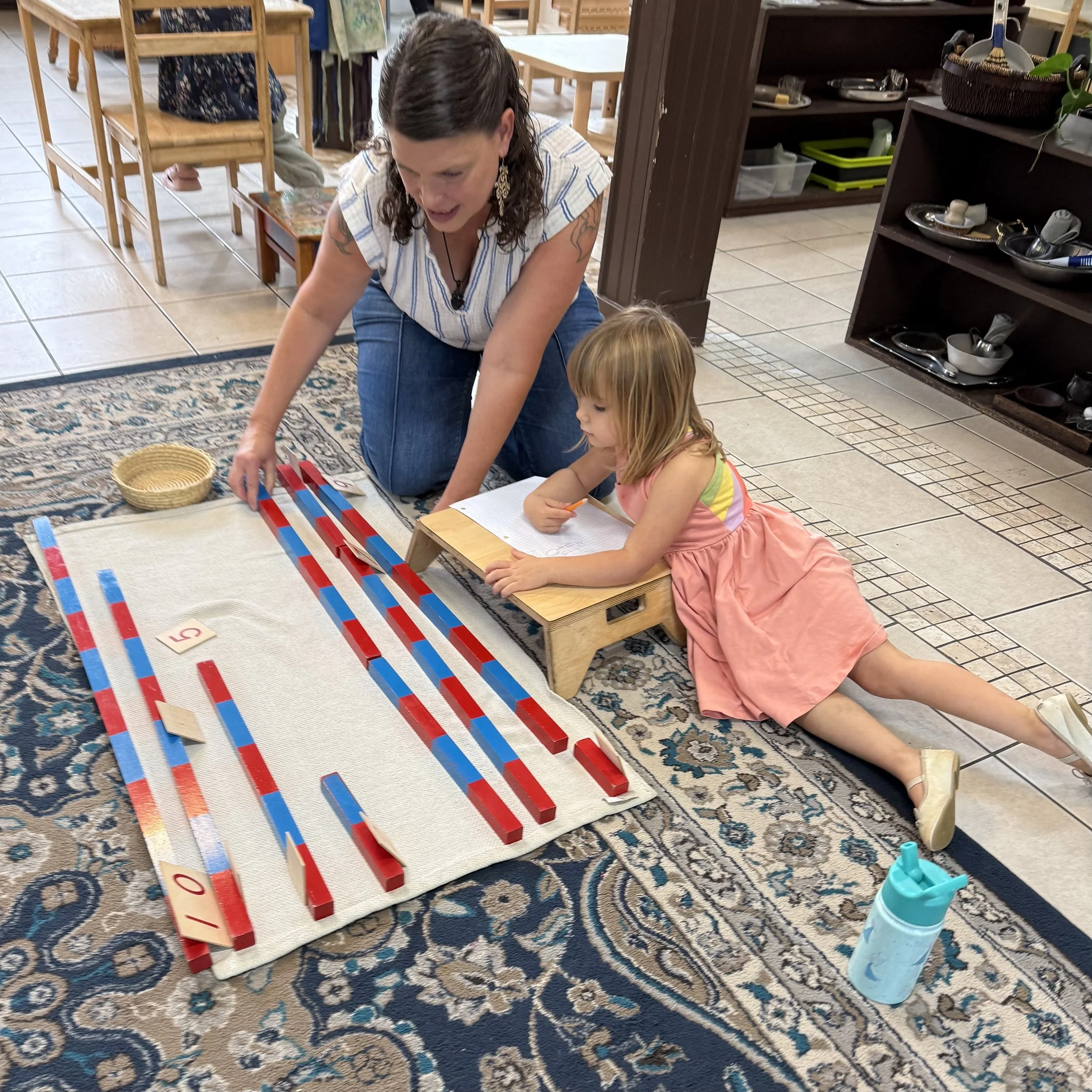
Math: Number Rods
“Here is an essential principle of education: to teach details is to bring confusion; to establish the relationship between things is to bring knowledge.” — Dr. Maria Montessori, From Childhood to Adolescence
When the foundation of basic Mathematical principles has been laid, the Montessori guide introduces to the child early materials for counting – such as the Number Rods and Spindle Boxes. The Number Rods are ten base-10 (centimeter) planks of wood with sections painted alternately red and blue, arranged in order of length, creating a kind of visual staircase when set on a rug.
The Spindle Boxes contain ten compartments that hold each quantity 0-9, and the 45 spindles are functional items (used in Dr. Montessori’s classrooms in the the early 1900s for gathering wool to transform into yarn) held by a child’s hand and placed in the box with the corresponding symbol/ numeral.
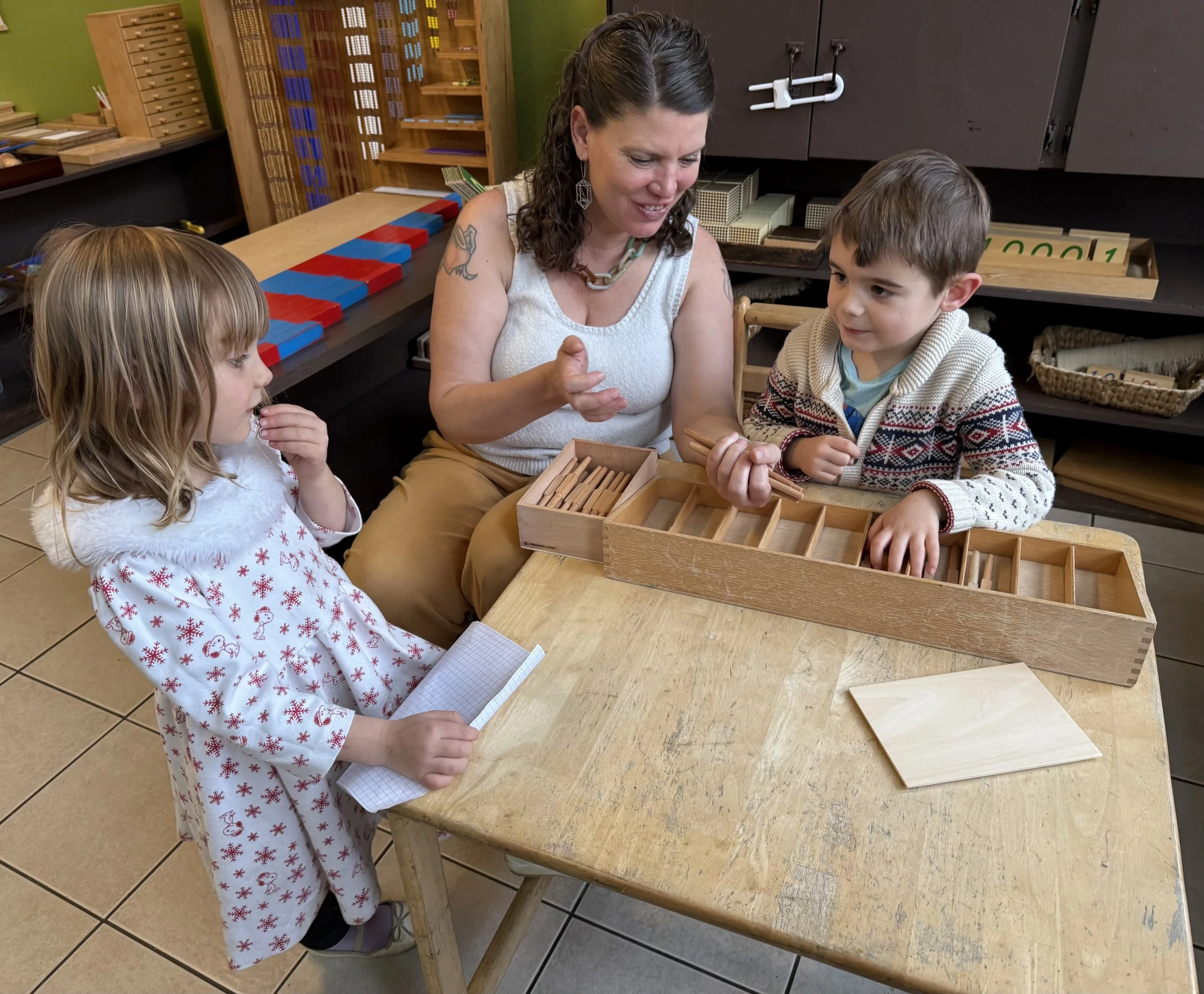
Math: Spindle Boxes
Cards and Counters are 55 red disks that assist with the child’s understanding of odd and even numbers 1-10 through the visual sense. The quantity of counters is placed below each numeral card.
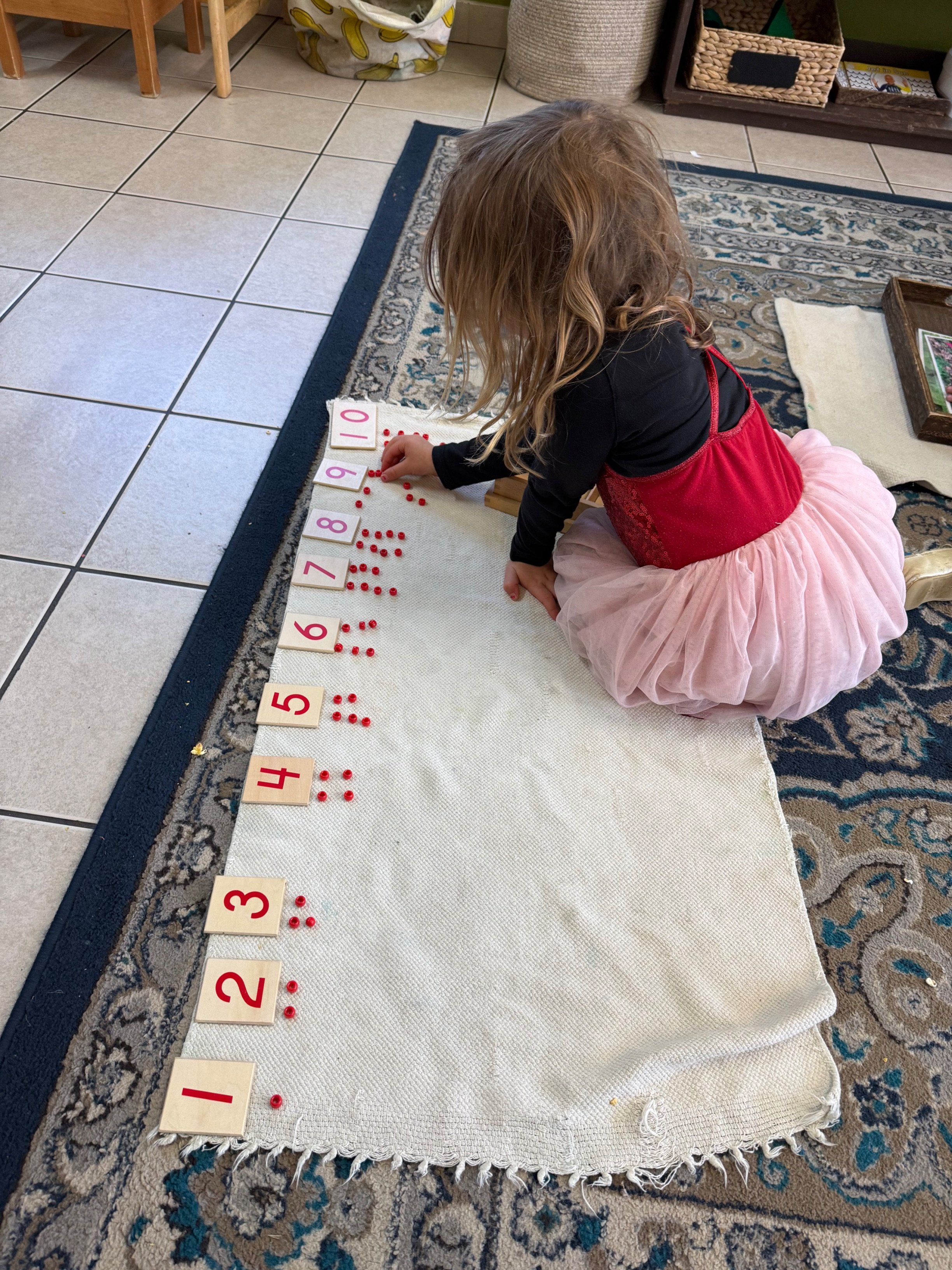
Math: Cards and Counters
“Children display a universal love of mathematics, which is par excellence the science of precision, order, and intelligence.” — Dr. Maria Montessori
Later, after a child understands concepts of quantity up to ten, they may explore numerals one through one hundred in ten rows of tens on the 100 board, a control chart of one hundred blank grid squares paired with a box of numeral tiles from 1-100. Children who are very engaged with this work and want to do more often compose the numerals on grid paper, by looking at the 100 Board and transferring the numerals from visual presentation to handwritten form.
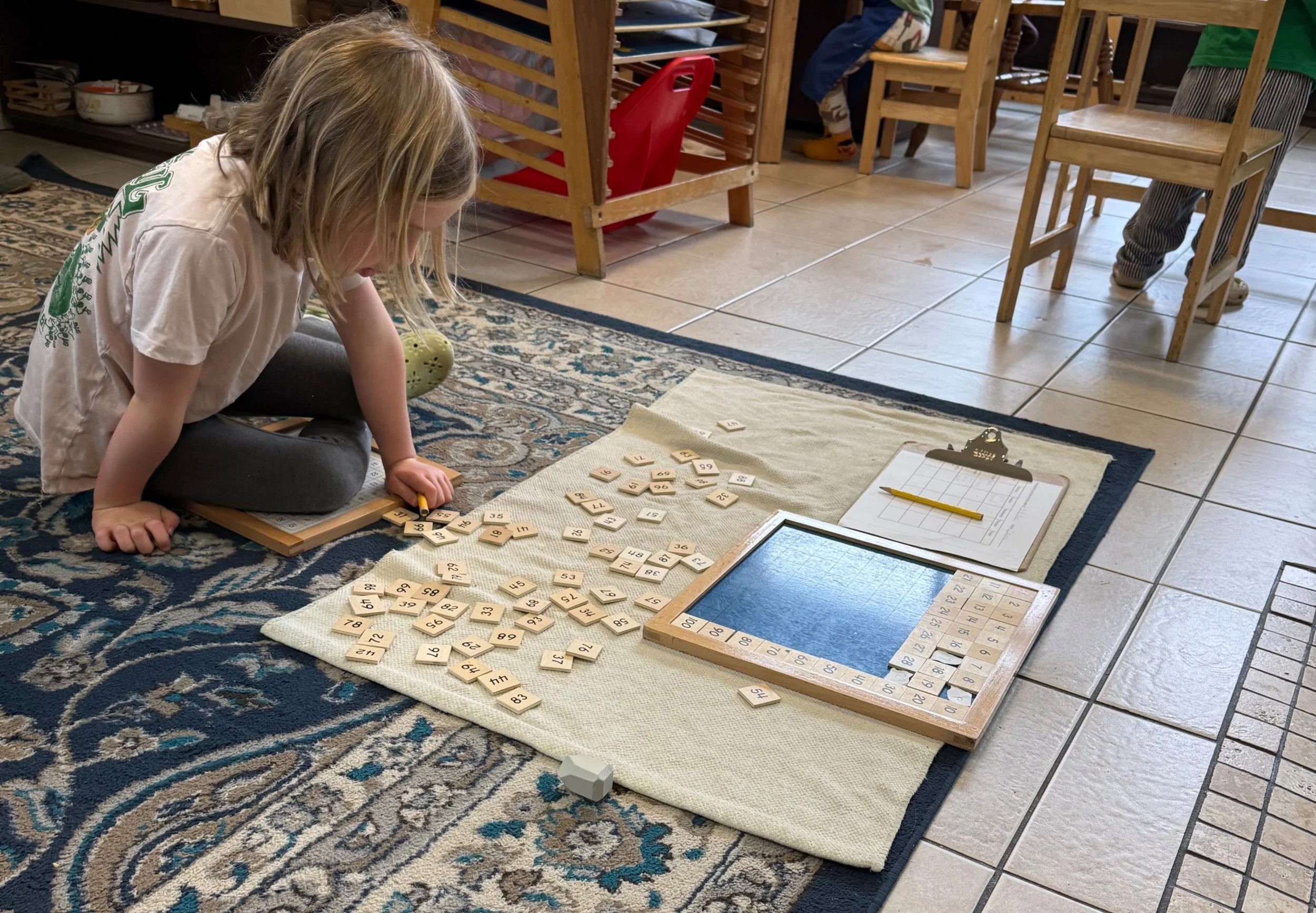
Math: The 100 Board
The Golden Bead material gives a visual representation of quantities from 1 to 9999, including color-coded numeral symbols for the units, tens, hundreds, and thousands. Children love doing this big work of numbers as partners – especially as it involves fetching quantities of items in baskets. The child practices (numeral) symbol-quantity association and may eventually use the material to perform the four Math operations: Addition, Subtraction, Multiplication, and Division.
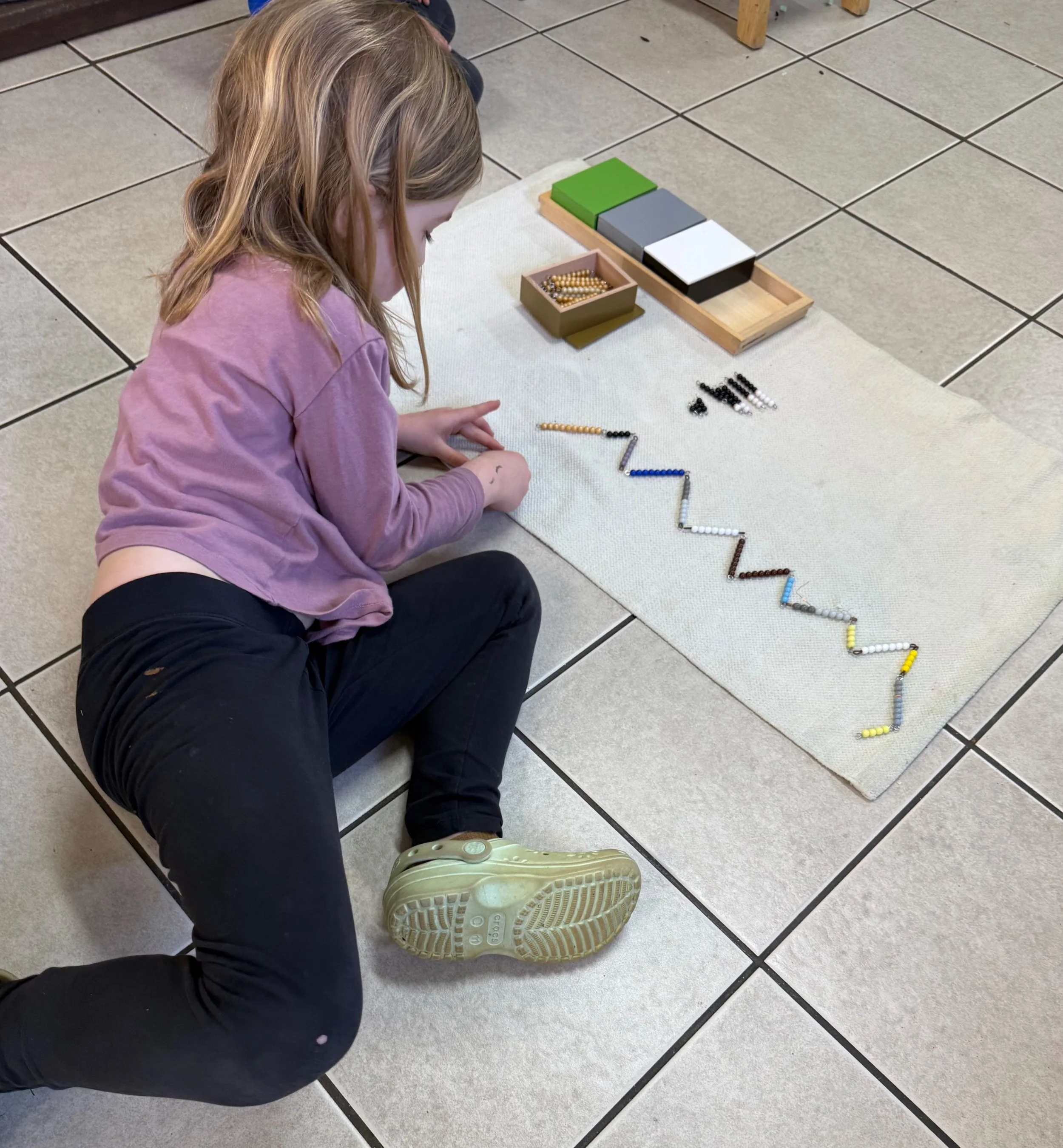
Math: Snake Game Addition
After the Golden Beads, children may move further into abstraction with the Math Operations using a variety of hands-on materials to maintain interest and allow for variable learning styles. The Snake Game can be used for both Addition and Subtraction and involves three boxes of beads – golden ten bars, black and white “magpie” bars forming a short stair, and colorful beads corresponding to the Bead Cabinet (used for skip counting and squaring numbers. The child uses the colored beads to make a "snake”, then counts the beads and exchanges them for golden bars of ten and the black and white “magpie” beads for remainders. Eventually the entire snake is golden with possibly one black and white bar at the "tail".
Math: Addition Strip Board
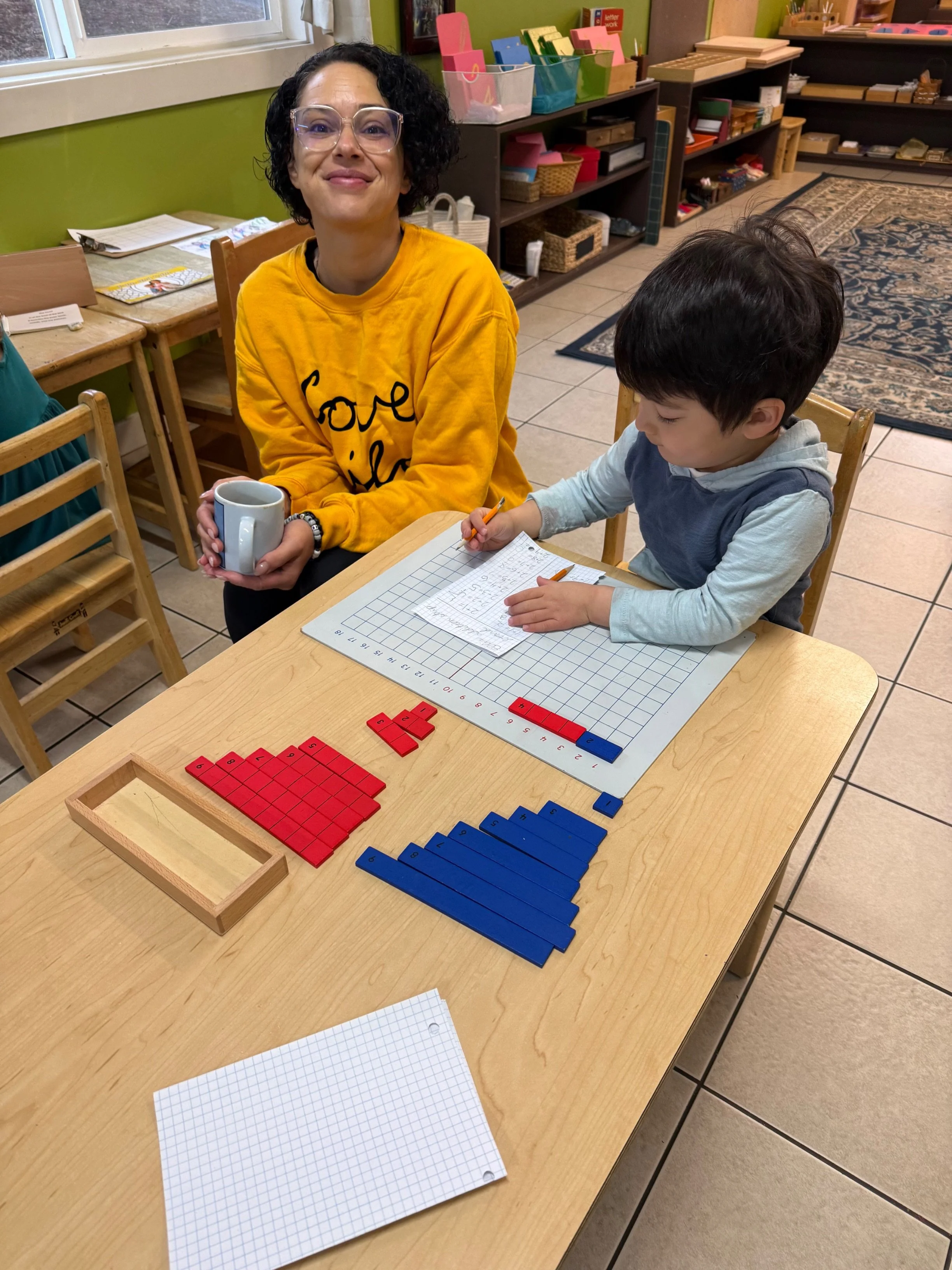
Addition and Subtraction Strip Boards contain grid squares for numerals 0-18. The child places red and blue wood planks horizontally and combines them to create visual number sentences. (Subtraction also uses natural wood planks.) After completing all the pairs of wood planks, an engaged child may choose to compose their equations in Math facts booklets.
“Praise, help, or even a look, may be enough to interrupt him, or destroy the activity.” — Dr. Maria Montessori, The Absorbent Mind
Math: Stamp Game Multiplication
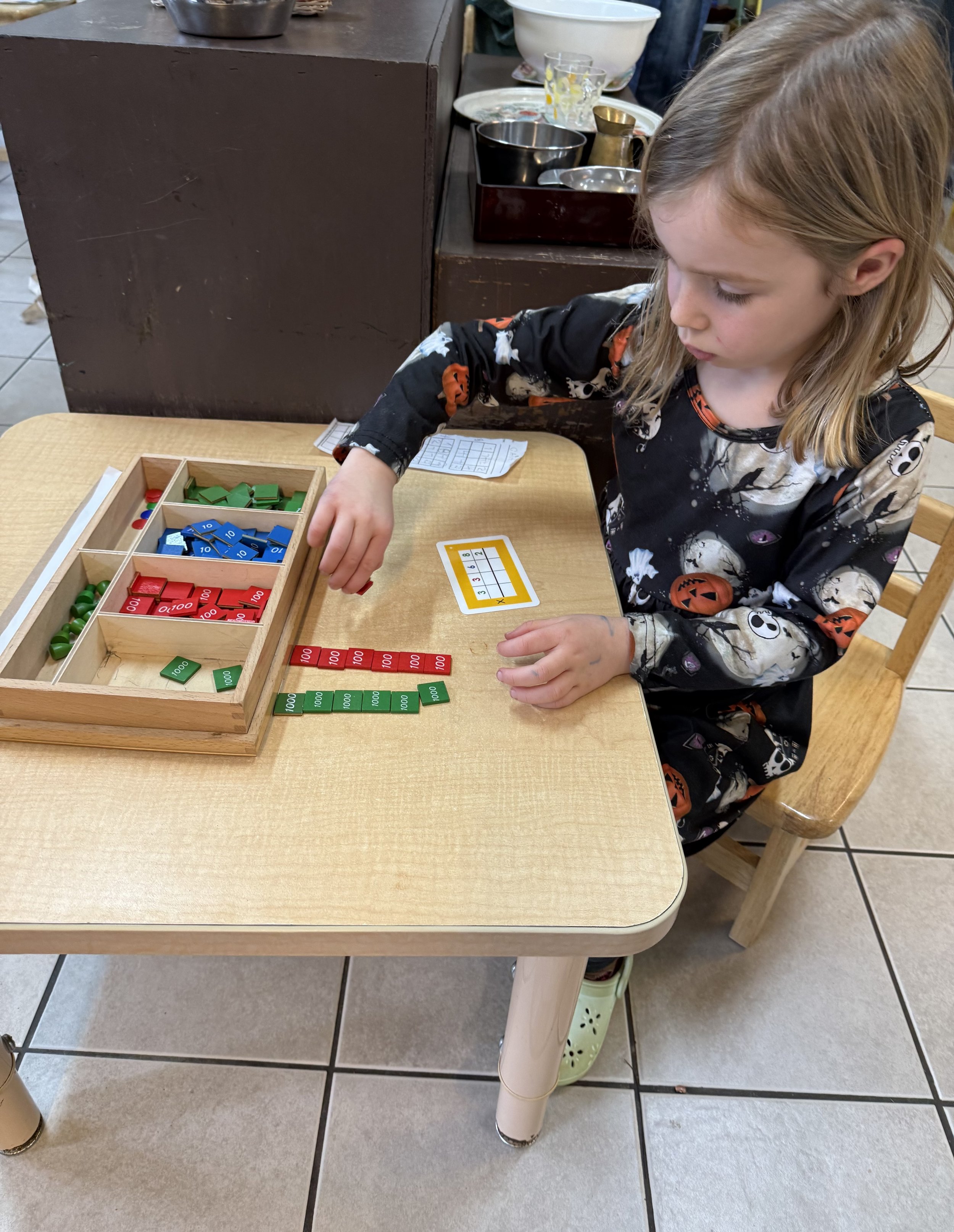
The Stamp Game is a color-coded tile game box similar to the Golden Beads – yet abstracted. Units are green tiles, tens are blue tiles, hundreds are red tiles, and unit thousands follow the pattern and are also green. These are arranged according to place value to make a four-digit numeral. The Stamp Game can also be used for all four Math operations.
Math: Multiplication Bead Bars
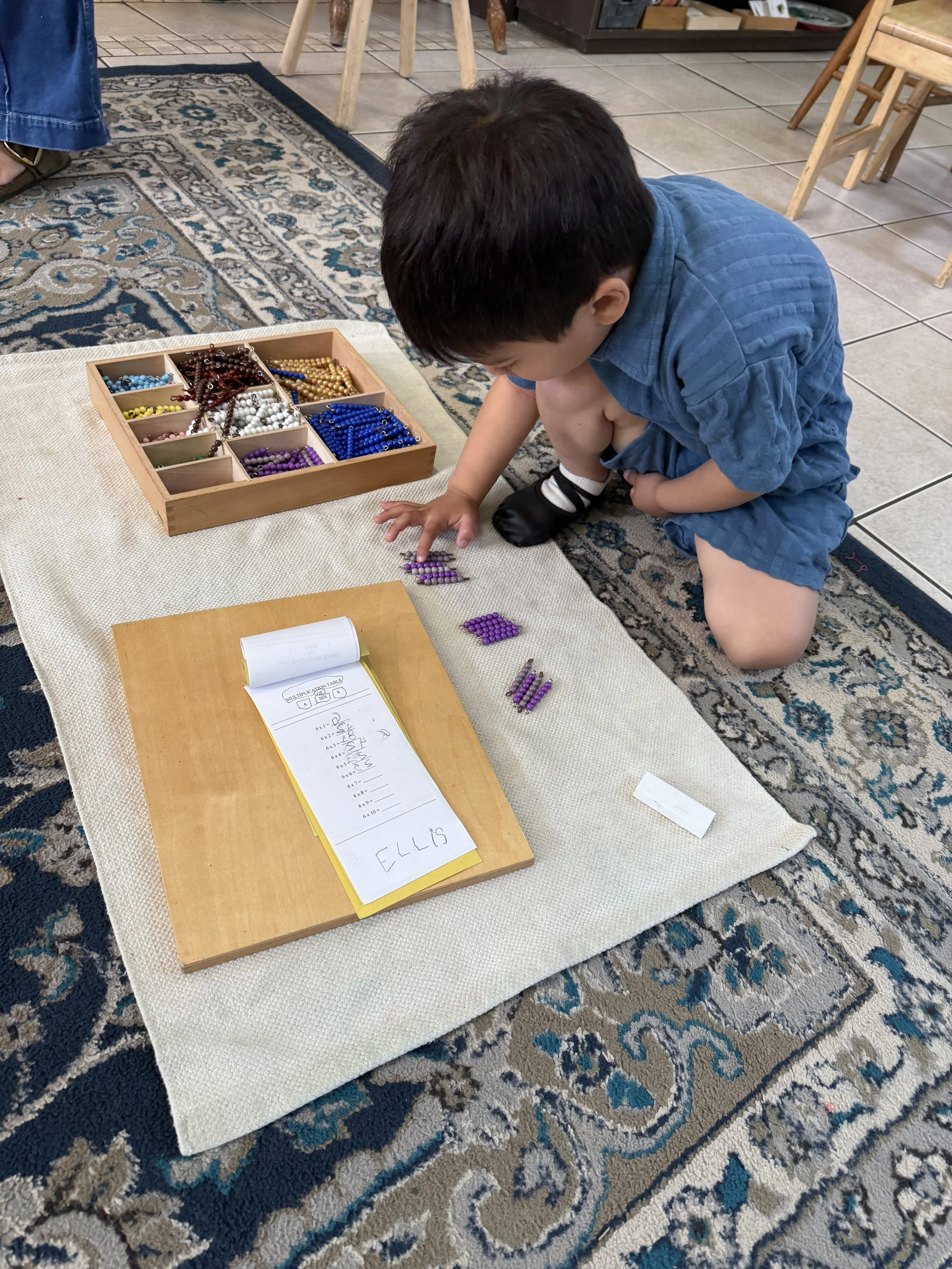
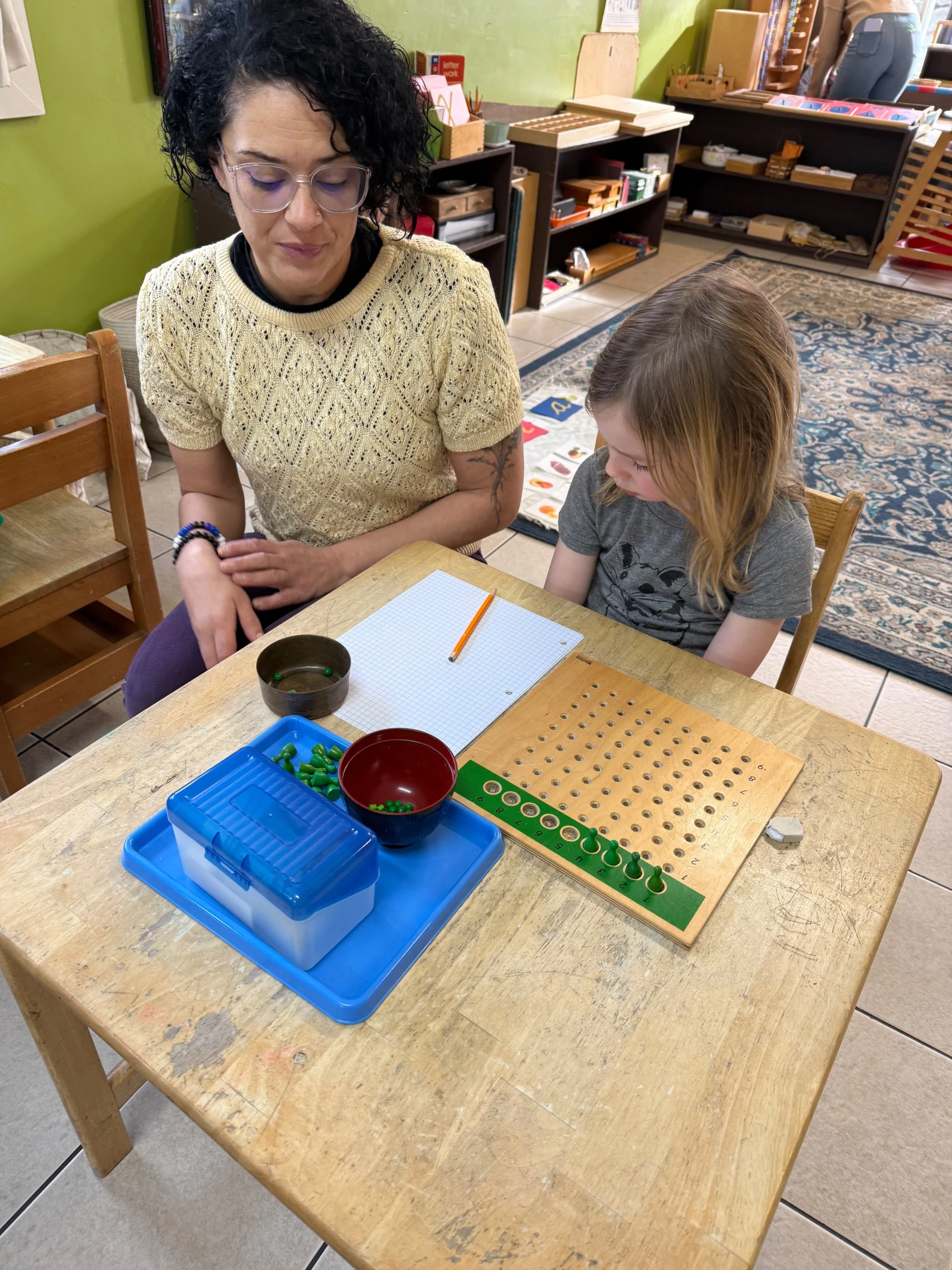
Other Math materials used for Math facts include the Multiplication Bead Bars (like those found in the Bead Cabinet) and the Unit Division Board – which uses green beads and “skittle” divisors (not the candy, but resembling figures) on a board. Like place value in Math, the Math Operations are also color-coded! This makes the materials very attractive and consistent to children, encouraging their intrinsic motivation to practice to their hearts’ content!
Math: Unit Division Board
The Math Area is the last curricular area presented to a child in the Montessori classroom, where Math concepts are first presented in concrete, visual and tactile experiences of quantity – and eventually move toward abstraction when the child is ready. The Montessori Math materials are beautiful and attractive to children, so touching them is a pleasure!